
ODATANO on Cardano
@odatano/core is the OData V4 API for the Cardano blockchain. Blocks, transactions, addresses, UTxOs, pools and DReps are OData entities. ADA, multi-asset, mint and Plutus V3 transactions are OData actions that return unsigned CBOR. A wallet, a CLI key or an HSM signs, the service submits. Fiori, Excel, Power BI, any OData client and AI agents call the same routes.
It runs hosted at api.odatano.dev, standalone from the repo or Docker image, or as a plugin in your SAP CAP app. Needs Node.js 22.5 or newer and @sap/cds 10.
Services
| Service | Path | What |
|---|---|---|
CardanoODataService | /odata/v4/cardano-odata/ | Read: 22 entities, 19 actions. Lazy indexing with TTL refresh |
CardanoTransactionService | /odata/v4/cardano-transaction/ | Build and submit: 6 build actions, submit, status, utilities |
CardanoSignService | /odata/v4/cardano-sign/ | Signing requests, signature verification, HSM signing |
CardanoIndexerService | /odata/v4/cardano-indexer/ | Chain crawler: sync state, reorg log, pause and resume. Off by default |
CardanoWorkerService | /odata/v4/cardano-worker/ | Server-side wallet jobs: build, sign, submit, confirm. Off by default |
CardanoAgentService | /odata/v4/cardano-agent/ | Scoped, budgeted bearer tokens for agents. Off by default |
Every entity set takes $filter, $select, $expand, $orderby, $top, $skip and $count. Actions are POST with a JSON body. $metadata carries the full schema. All services require an authenticated user; getLiveness and VerifyDataSignature are public.
Read
| Topic | Entity | Actions |
|---|---|---|
| Network | NetworkInformation | GetNetworkInformation |
| Blocks, epochs | Blocks, Epochs | GetBlockByHash, GetLatestBlock, GetEpochByNumber, GetLatestEpoch |
| Transactions | Transactions, inputs, outputs, TransactionMetadata | GetTransactionByHash, GetMetadataByTxHash, ParseTransactionCbor |
| Addresses | Addresses, AddressUTxOs, AddressAssets, AddressTransactions | GetAddressByBech32, GetUTxOsByAddress, GetUTxOsByCredential, GetAssetsByAddress, GetLatestTransactionsByAddress |
| Assets | Assets, AssetHistory | GetAssetInfo, GetAssetHistory |
| Staking, governance | Pools, Accounts, Dreps, epoch snapshots | GetPoolById, GetAccountByStakeAddress, GetDrepById |
| Protocol | LedgerProtocolParameters | GetLedgerProtocolParameters |
Actions fetch from the chain on a cache miss and store the row. Entity sets read the cache, so a $filter over Transactions covers what was fetched before, or everything the crawler pre-synced.
GET  /odata/v4/cardano-odata/Blocks?$orderby=height desc&$top=1
GET  /odata/v4/cardano-odata/Transactions?$filter=slot gt 12345678&$top=10
GET  /odata/v4/cardano-odata/Transactions('<hash>')?$expand=inputs,outputs
POST /odata/v4/cardano-odata/GetUTxOsByAddress   {"address": "addr_test1..."}
Transactions: Build, Sign, Submit
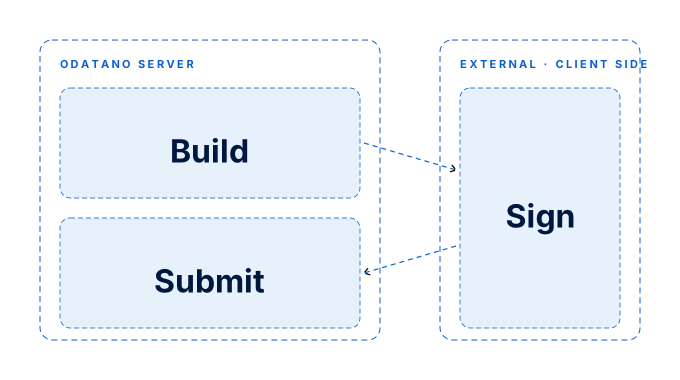
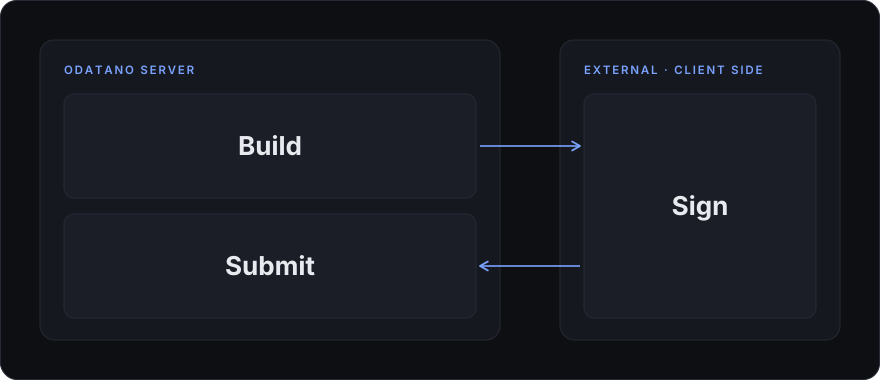
The server never holds a private key. A build returns unsignedTxCbor, txBodyHash, fee and a buildId. The client signs. The server verifies the witnesses and submits.
Build
| Action | What it builds |
|---|---|
BuildSimpleAdaTransaction | ADA transfer. Optional assets, inline datum, lock at a script address, CIP-33 reference script |
BuildTransactionWithMetadata | Transfer with transaction metadata, e.g. CIP-20 or a label-1447 anchor |
BuildMultiAssetTransaction | Native assets plus ADA to one recipient |
BuildMintTransaction | Mint or burn under a Plutus V3 policy. Required signers, reference inputs, metadata |
BuildPlutusSpendTransaction | Spend a script UTxO: validator, redeemer, continuing datum, extra outputs, combined mint |
SetCollateral | Makes sure an ADA-only collateral UTxO exists |
Every build takes senderAddress, recipientAddress and lovelaceAmount, plus the fields of its kind. Full parameter tables: Transaction Workflow on GitHub.
curl -X POST http://localhost:4004/odata/v4/cardano-transaction/BuildSimpleAdaTransaction \
  -H "Content-Type: application/json" \
  -d '{"senderAddress":"addr_test1...","recipientAddress":"addr_test1...","lovelaceAmount":10000000}'
Sign
| Method | signerType | Where the key lives |
|---|---|---|
| Cardano CLI | cardano-cli | a .skey file, backend automation |
| CIP-30 wallet | browser-wallet | browser extension: Lace, Eternl, Yoroi |
| Hardware wallet | hardware-wallet | Ledger or Trezor through a wallet adapter |
| HSM | server side | PKCS#11 device, the key never leaves the chip |
External signing: Build* → CreateSigningRequest → client signs → SubmitVerifiedTransaction. The request moves pending → verified → submitted and expires after 30 minutes. VerifySignature checks CBOR, body hash, fee payer and required signers without submitting.
HSM signing: Build* → SignAndSubmitWithHsm. Needs hsm.enabled and a PKCS#11 module; failures at start are non-fatal and the HSM actions answer ODATANO_HSM_UNAVAILABLE.
Submit
| Action | Params |
|---|---|
SubmitTransaction | buildId, signedTxCbor |
SubmitSignedTransaction | signedTxCbor, network |
CheckSubmissionStatus | bound on TransactionSubmissions(id) |
A duplicate submit answers ODATANO_TX_ALREADY_SUBMITTED. DeriveScriptAddress and ExtractPaymentKeyHash are pure helpers without a network call. VerifyDataSignature checks a CIP-30 signData signature for wallet login and is public.
Plutus V3
Buildooor is the sole transaction builder and computes the script data hash for mint and spend by construction. Plutus V1 and V2 scripts are rejected at build time.
| Flow | Actions |
|---|---|
| Lock | BuildSimpleAdaTransaction with lockOnScript: true and outputDatumJson |
| Spend | SetCollateral, then BuildPlutusSpendTransaction with validatorScript, redeemerJson, scriptTxHash, scriptOutputIndex |
| Mint | BuildMintTransaction with mintingPolicyScript and mintActionsJson; negative quantities burn |
| State machine | spend with lockOnScript: true and inlineDatumJson re-locks the next state; extraOutputsJson adds outputs |
| Spend and mint | mintActionsJson and mintingPolicyScript on BuildPlutusSpendTransaction, one atomic transaction |
Also supported: parameterised validators (scriptParamsJson), required signers (requiredSignersJson), CIP-31 reference inputs, CIP-33 reference scripts on every build action, validity windows (validityStartMs, validityEndMs), forced inputs and the __INPUT_IDX:<txHash>#<index>__ placeholder inside redeemers and datums. Script hex from Aiken or Plutus is passed as is, CBOR wrapper included.
Worked examples: TRACE (batch NFTs with a continuing datum) and QUANTIX (atomic mint against oracle feeds).
2.0 subsystems
Three optional services, each off by default and each with CAP events for in-process consumers.
- Crawler (
crawler.enabled): pre-syncs blocks and transactions from a start slot into the cache, with a sync cursor, reorg log and pause or resume. Chain-sync over Ogmios or pagination over Blockfrost and Koios. - Wallet worker (
walletWorker.enabled): server-side wallets run build, sign, submit and confirm as one job.SubmitWalletJobtakes the same payload as the matching build action. Keys never pass through the API. - Agent grants (
agentGrants.enabled): an admin issues anodat_…token with an action allow list, an optional wallet, a daily budget and an expiry. A request withx-agent-tokenruns as that grant, never as the operator. HSM signing and admin actions are never grantable.
Run it
As a CAP plugin
{
  "cds": {
    "requires": {
      "[development]": { "auth": { "kind": "dummy" } },
      "db": { "kind": "sqlite", "credentials": { "url": "db.sqlite" } },
      "odatano-core": {
        "network": "preview",
        "backends": ["blockfrost", "koios"]
      }
    }
  }
}
Then cds deploy --to sqlite and cds watch. Secrets such as the Blockfrost key belong in .env. Upgrading a consumer from 1.x: run cds deploy once, 2.0 adds six tables.
Standalone
git clone https://github.com/ODATANO/ODATANO && cd ODATANO
npm ci
cp .env.example .env       # NETWORK, BACKENDS, BLOCKFROST_API_KEY
cds deploy --to sqlite
cds serve
docker compose up -d brings up a local cardano-node, Ogmios and ODATANO on preview. The release workflow publishes ghcr.io/odatano/odatano; the image runs with HTTP basic auth (ODATANO_HTTP_PASSWORD) and SQLite or PostgreSQL (ODATANO_DB_URL).
Configuration
Plugin keys sit under cds.requires.odatano-core. Standalone reads environment variables. A plugin key wins over the variable.
| Key | Env | Default | Meaning |
|---|---|---|---|
network | NETWORK | preview | mainnet, preview or preprod |
backends | BACKENDS | ["koios"] | priority order; first is live, the rest historical fallback |
blockfrostApiKey | BLOCKFROST_API_KEY | required with blockfrost unless a custom backend is set | |
blockfrostCustomBackend | BLOCKFROST_CUSTOM_BACKEND | self-hosted Blockfrost-compatible node, e.g. Dolos MiniBF | |
koiosApiKey | KOIOS_API_KEY | optional Koios bearer | |
ogmiosUrl | OGMIOS_URL | ws://localhost:1337 | required with ogmios |
primaryTimeoutMs, fallbackTimeoutMs | PRIMARY_TIMEOUT_MS, FALLBACK_TIMEOUT_MS | 30000, 60000 | per backend |
indexTtlMs | INDEX_TTL_MS | 3600000 | cache TTL for addresses and accounts |
hsm.*, crawler.*, walletWorker.*, agentGrants.* | HSM_*, CRAWLER_*, WALLET_WORKER_*, AGENT_GRANTS_* | off | the optional subsystems |
Backends: Ogmios answers live queries and submits, Blockfrost and Koios serve history. A circuit breaker moves a failing backend out of rotation and retries after a cooldown. Production runs NODE_ENV=production with HANA and XSUAA; the full key list and the deployment guides are on GitHub.
Errors
Every error is { code, message, target? }. Branch on code, not on the HTTP status.
| Code | HTTP | Meaning |
|---|---|---|
ODATANO_INVALID_INPUT | 400 | bad address or hash, missing field, JSON over limit |
ODATANO_NOT_FOUND | 404 | not on chain |
ODATANO_INSUFFICIENT_FUNDS | 400 | the sender cannot cover the build |
ODATANO_TX_VALIDATION_FAILED | 400 | witness, signature or CBOR invalid |
ODATANO_SCRIPT_VALIDATION_FAILED | 400 | Plutus script failed |
ODATANO_TX_ALREADY_SUBMITTED | 409 | in the mempool or on chain |
ODATANO_PROVIDER_RATE_LIMITED | 429 | Blockfrost or Koios limit |
ODATANO_PROVIDER_UNAVAILABLE | 503 | backend timeout or 5xx |
ODATANO_HSM_UNAVAILABLE | 503 | HSM device or session missing |
On GitHub
The repo holds the detail this page leaves out. github.com/ODATANO/ODATANO
- User Guide: entities, query patterns, examples
- Transaction Workflow: every build parameter, signing methods
- Developer Guide: architecture, plugin internals, public API, tests
- Security Guide: XSUAA, scopes, HSM, audit trail
- Backend Configuration: routing, recommended setups, self-hosted Blockfrost
- Docker Deployment and Production Deployment: compose stack, SAP BTP, HANA
- Error Handling: class hierarchy and normalisation
- SAP Integration Examples and ABAP examples
- Changelog · npm: @odatano/core